• Home
  • Articles
    • Front Page
    • General Interest
    • Letters to the Editor
    • Snippets
  • Our Community
    • Our People
    • Question of the Week
    • Be Seen
    • Jobs in The Central West
  • Special Interests
    • Rural Round Up
    • Health & Wellness
    • Loving Local Living
    • My Place
    • Real Estate
  • Sports
    • Bowls
    • Canowindra Junior Rugby League
    • Rugby League
    • Cricket
    • Footy Tipping Competition
    • Golf
    • Rugby Union
    • Swimming
    • Touch Football Results
    • Tennis
    • Other
  • Competitions
  • Classifieds
  • Contact Us
    • Contact Us
    • Advertise with Us
    • Testimonials
    • Subscribe to the Phoenix
    • Submit an Article

The Canowindra Phoenix

Your free weekly guide to what's happening in and around Canowindra.

Home » Traditional Wiradjuri Burials In Molong

Traditional Wiradjuri Burials In Molong

4 March, 2021 By Canowindra Phoenix Editor

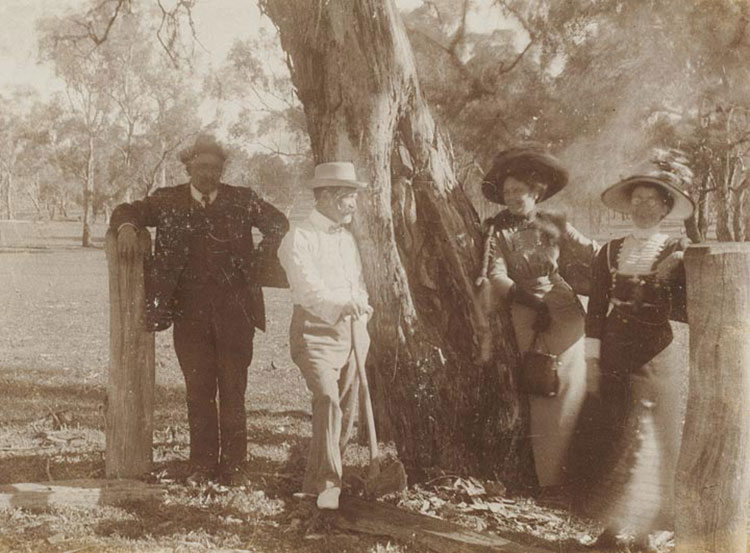
Amateur anthropologist Edmund Milne and a group of friends standing next to Aboriginal Arborglyphs (carved trees) in Gamboola, near Molong in 1912.

Ground-breaking research on a Wiradjuri burial site at Molong could soon reveal new insights into traditional funeral practices, highlighting the importance of Aboriginal cultural heritage in the Central Tablelands region of NSW.

Central Tablelands Local Land Services and La Trobe University last week are undertaking radar technology to research ancient customs on the Garra Travelling Stock Reserve (TSR) south east of Molong.

The La Trobe University archaeology team are using ground penetrating radar to locate burial sites, focusing initially on a carved tree, believed to mark the grave of a highly respected Aboriginal man.

“Carved trees were generally reserved for special individuals, that we refer to as a man of high degree,” explained Wiradjuri man and Senior Land Services Officer (Indigenous Communities), Greg Ingram.

“Once the burial spot has been confirmed, the archaeologists will use three-dimensional mapping to survey the area and identify clues about how traditional burials were conducted in the past.”

The Local Land Services funded research will include a search for other potential burial sites in the vicinity of the remaining carved tree.

“There are a lot of large stumps at this site,” said Mr Ingram.

“It’s possible that these stumps may have been carved trees that have been cut down, suggesting this could be a traditional burial ground containing more than one grave site.”

Several local Aboriginal organisations are involved in the field work on site, ensuring engagement and partnership in the project with the local Aboriginal community.

“There hasn’t been a lot of research on traditional Wiradjuri funeral practices, so this is a significant project,” said Mr Ingram.

Filed Under: Articles, General Interest

Click here to download the recent issue (875) of The Canowindra Phoenix (1.8MB PDF) – 30th April 2026

Search the Phoenix

STAY CONNECTED

The Canowindra Phoenix would like to thank you, our Facebook friends, for your continued support and readership!

Contact the Phoenix

Street Address: 84 Gaskill Street Canowindra NSW 2804
Postal Address: PO Box 203 Canowindra NSW 2804
Phone: (02) 6344 1846

Editorial Phone – 6344 1846
editor@canowindraphoenix.com.au

Sales Phone – 0498 202 025
sales@canowindraphoenix.com.au

Submit an Article

We are always looking for new articles of interest to the local community.

Please feel free to submit an article for possible inclusion in a future issue.

To submit an article, click here to use our online article submission form.

Receive The Phoenix via Email

* indicates required

Copyright © 2026 · Website setup and support: CompleteWPCare