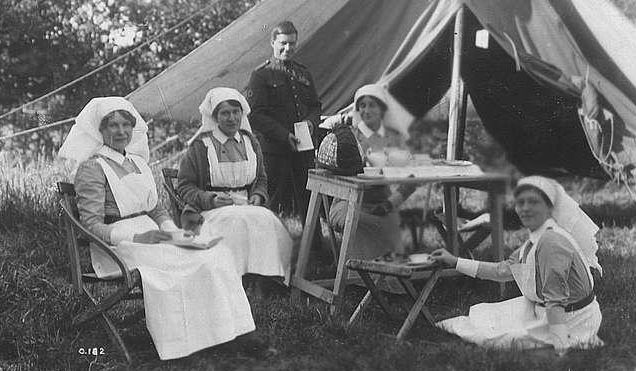
Australian Army Nurses played an integral role in Australia’s World War I campaign.
The first landing at Gallipoli on 25 April 1915 conjures up images of Australian soldiers charging bravely up the steep and barren slopes from Anzac Cove. Another image from that day is Australian nurses attending to hundreds of wounded men on a hospital ship.
In late 1914, 25 Australian Army Nurses sailed with the first convoy of the AIF to support the Australian Army overseas. The sea voyage formed part of the training for the ambulance, medical and nursing personnel. Some ships in the convoy had wellequipped hospitals. The nurses in charge lectured and trained ambulance staff and regimental medical detachments, but no training could prepare them for what they would be required to face.
After arriving in England Nurses were deployed either to hospital ships positioned near battlefields inaccessible by land, to clearing stations, or makeshift wards close to the frontline where troops could be cared for before being sent on for better care, or to permanent or temporary hospitals.
On the 25th April 1915, the HMHS Gascon was anchored off ANZAC Cove, by nightfall 557 wounded soldiers had been ferried onboard by boats or barges, the troops were laying on the decks and in the confined wards below deck.
Sister Ella Tucker wrote: “The wounded from the landing commenced to come on board at 9am and poured into the ship’s wards from barges and boats. The majority still had on their field dressing and a number of these were soaked through. Two orderlies cut off the patient’s clothes and I started immediately with dressings. There were 76 patients in my ward and I did not finish until 2am.”
Ella stayed with the Gascon for the next 9 months. The Gascon transported over 8,000 sick and wounded soldiers between Gallipoli and military hospitals. Ella’s diary entry during a voyage in May 1915 reflects the stressful nature of her work:
“Every night there are two or three deaths, sometimes five or six; it’s just awful flying from one ward into another … each night is a nightmare, the patients’ faces all look so pale with the flickering ship’s lights.”
Lieutenant Harold Williams was wounded at Peronne in September 1918. After his experience in a casualty clearing station at Daours, Harold recalled admiration for the nurses’ work:
In large marquees, nurses, pale and weary beyond words, hurried about. That these women worked their long hours among such surroundings without collapsing spoke volumes for their will-power and sense of duty. The place reeked with the odours of blood, antiseptic dressings, and unwashed bodies … They saw soldiers in their most pitiful state — wounded, bloodstained, dirty, reeking of blood and filth.”
Records show that 2861 women in the Australian Army Nursing Service served overseas during World War I. Of those women, 25 died during their service, eight were awarded the Military Medal for Bravery.
Even the Armistice, when it eventually came on November 11 1918, brought little comfort. Nurses carried the burden of putting back together the victim of conflict, yet struggled to maintain their own physical and mental health. For many, their return to Australia was marred by ill-health, and what we would now call Post-traumatic stress disorder. Many suffered terrible depression and found joy impossible when they contemplated the sadness of empty homes and hearts.
They also displayed courage and resilience. They too were war’s victims.
Lest We Forget.