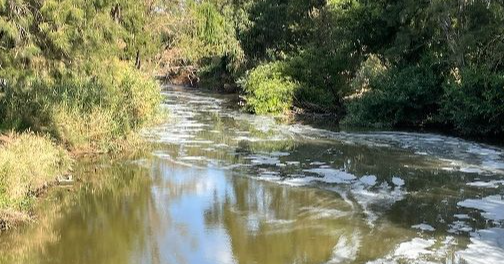
The toxic foam is currently visible on the surface of the Belubula River at Canowindra. Photo: Geoffrey Yeo.
Shadow Minister for Water, Steph Cooke, has expressed grave concern over the reappearance of highly toxic PFAS-contaminated foam in the Belubula River near Canowindra.
Recent laboratory tests have shown levels of PFOS up to 67,500 times higher than current drinking water guidelines.
“This is a serious environmental and public health issue that cannot be ignored,” Ms Cooke said.
“The foam returning to the Belubula River is more concentrated than ever, and the risks to livestock, irrigation, and the river’s delicate ecosystem are unacceptable.
“Local landholders and communities are rightfully alarmed, and they deserve immediate action and clear guidance.”
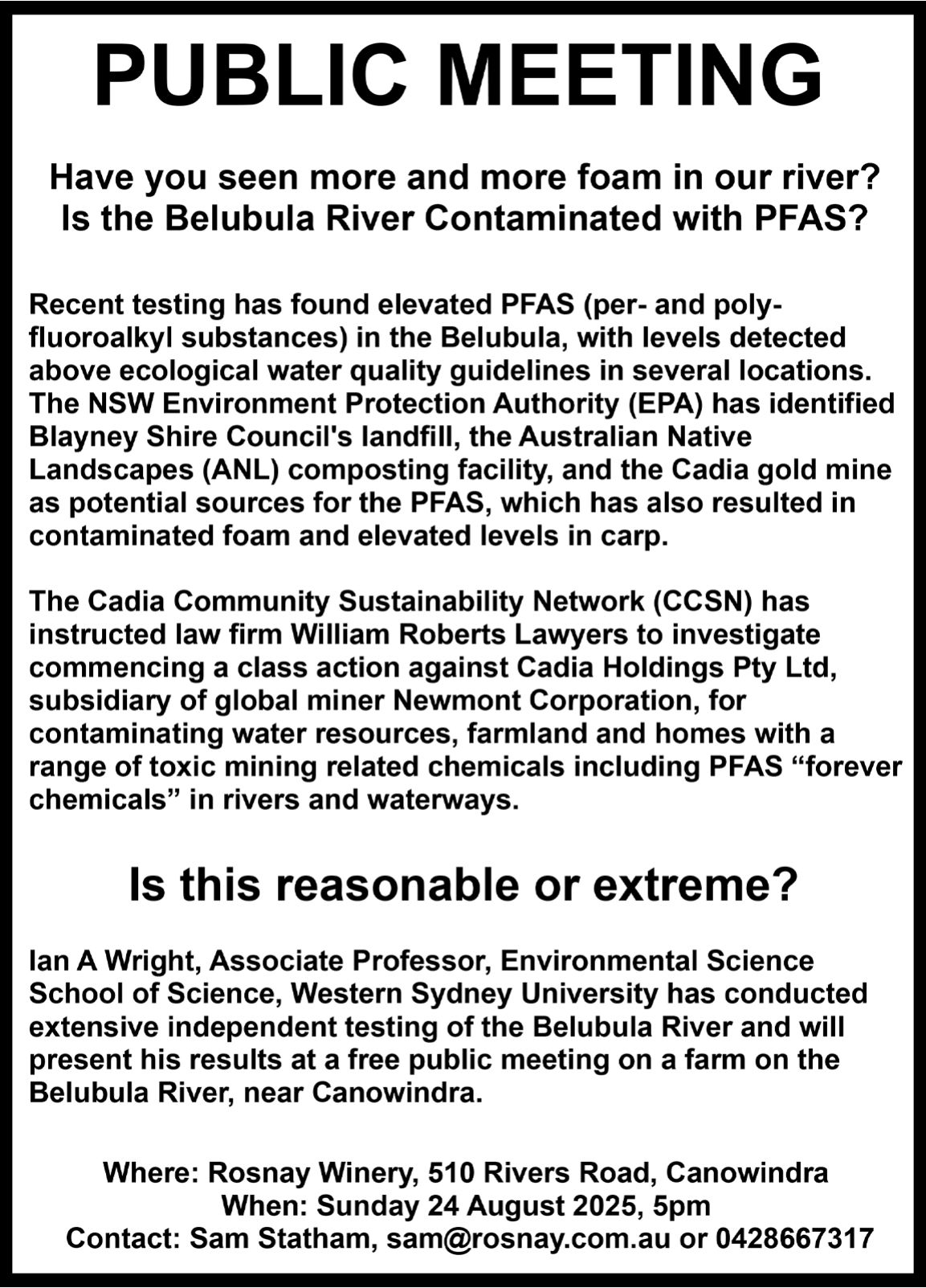
Concerned Canowindra residents are invited to attend a communtiy meeting this Sunday 24 August, 5pm at Rosnay Winery, 510 Rivers Road, Canowindra. Ian A Wright, Associate Professor, Environmental Science School of Science, Western Sydney University has conducted extensive independent testing of the Belubula River and will present his results at the meeting.
“There are currently large patches of foam on the Belubula River – I have tested (and published a science research paper) on Belubula River foam. It is extremely hazardous and can contain highly concentrated PFAS and metal content.
“In my opinion a public health warning should be made to all river uses to avoid floating river foam. I warned the EPA about this hazard on 12 August last year,” Ian Wright said.
Ms Cooke said the discovery reinforces the importance of the Select Committee on PFAS Contamination in Waterways and Drinking Water Supplies, which she helped draft the terms of reference.
The Committee is due to deliver its findings and recommendations on 18 September.
“Our communities have been calling for decisive leadership on PFAS from the Minns Labor Government,” Ms Cooke said.
“The Select Committee will provide a roadmap for action, but we cannot wait while contamination continues, and action must be taken as a matter of urgency.”
Ms Cooke is calling on the Minns Labor Government and the Environment Protection Authority to act immediately by commissioning independent monitoring of the Belubula River and surrounding waterways, and by issuing clear safety guidance to landholders, irrigators, and livestock owners.
Ms Cooke also praised local scientists and landholders for their tireless work in monitoring and documenting the contamination, noting that their efforts provide critical evidence to support immediate action.
“Landholders should never have to watch the river they rely on for their livelihoods turn into a toxic hazard,” Ms Cooke said.
“The Government must take responsibility and protect our communities, our environment, and our food security.”